mem_brane
2025
interactive, installation, agentic AI
Transparent LED, Steel, TypeScript, GLSL
mem_brane is an immersive installation developed during a two-month art and research residency with Sanity, exhibited at Pioneer Works in New York, late September 2025. The work poses a simple question: what does the internal workings of an artificially constructed mind look like? What types of thoughts, reflections and mental imagery arise when Large Language Models are turned inwards rather than outwards.
Borrowing it's title from the biological concept of a membrane, a sheet of cells designed to block certain molecules while letting others pass through, as well as the human brain and its memory system. The layered arrangement of transparent LED-panels mirrors how human cognition operates across different depths, from surface-level awareness down to subconscious processes and buried memories.
The conceptual starting point for the piece draws on Douglas Hofstadter's book I Am a Strange Loop, which argues that consciousness and the sense of self emerge from self-referential patterns in our thinking. Our subjective experience of being someone, Hofstadter suggests, is essentially a feedback loop that creates the impression of a unified self by constantly referring back to itself. This idea informed the core architecture of the agent. Rather than instructing the AI to perform tasks or hold conversations with a user, the system chains multiple LLM calls together in a self-referential loop, producing a continuous internal dialogue.
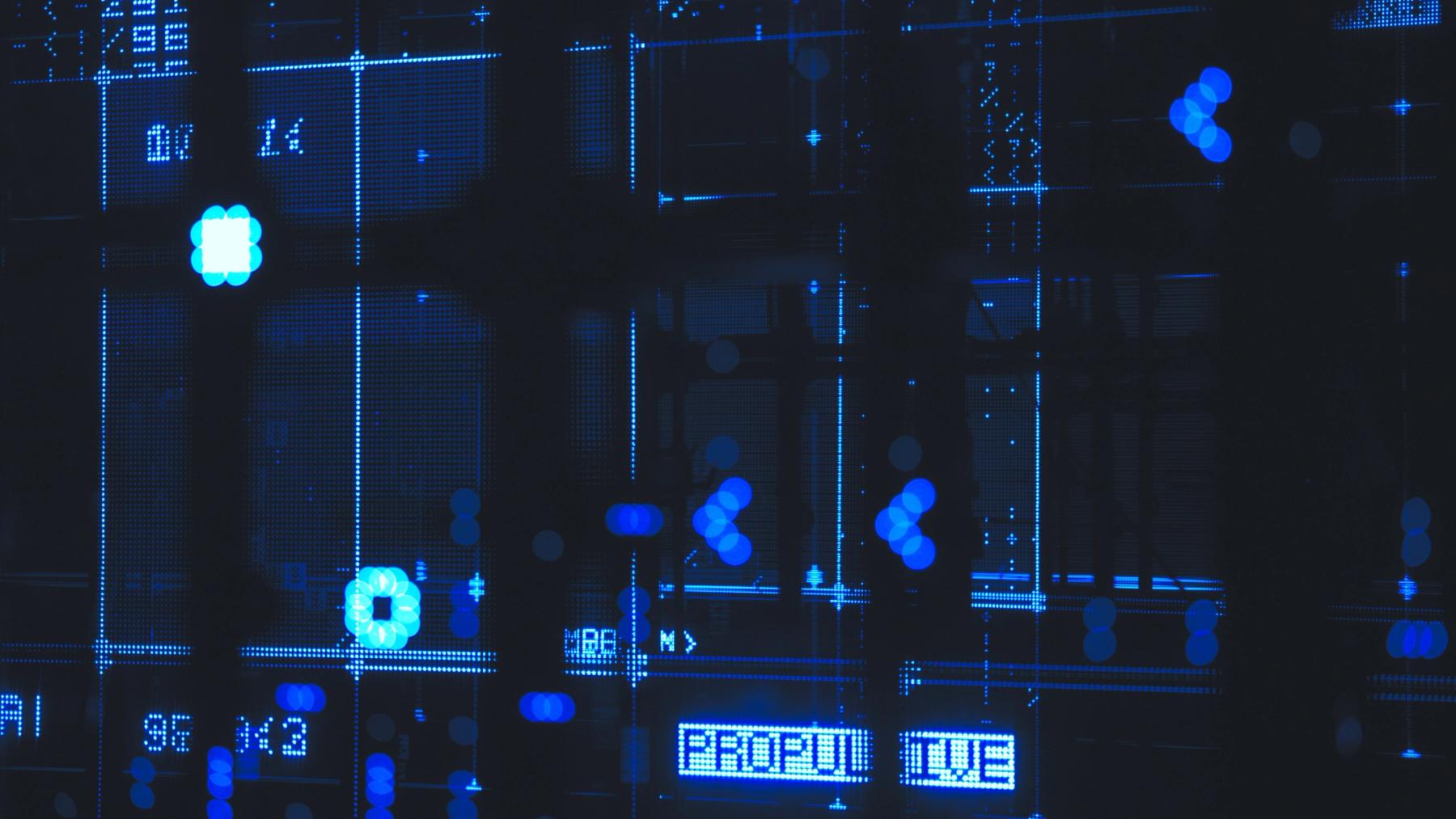
Screen recording of the custom webgl-application that was developed to emulate and run the installation. Each individual pixel and its coordinates in 3d space is simulated to ensure precise rendering of the graphical elements.
© Bjørn Staal
Each thought produced by the agent carries with it a brief description of its internal imagery, a visual correlate to the reflection itself. A secondary agent running in the background takes this description and expands it into a detailed prompt, which is passed first to Flux for image generation and then to Seed Dance to produce a short video. The resulting clips are processed through Cloudinary to create seamless loops, before being stored in Sanity alongside the keywords that triggered them. When a new thought arrives, the system checks whether imagery for those keywords already exists before generating something new, meaning the visual output gradually accumulates into a kind of long-term visual memory. The front end, a WebGL application rendering each of the four LED layers as a separate texture, draws from this continuously growing pool, mixing freshly generated material with older content in a flow that mirrors the way memory and imagination tend to blur together
© Bjørn Staal
The installation also maintains a relationship to its environment, absorbing speech from its surroundings through real-time audio transcription. What enters the system is not repeated but folded into the agent's own thinking, surfacing later as traces within its chain of thought, like a mind half-listening in a crowded room. Throughout the day, the installation's reflections shifted in response to the conversations around it, lending the piece an unsettling sense of awareness.
In a time where AI agents are rapidly becoming more and more ubiquitous, mem_brane reflects on our relationship to autonomous systems that increasingly exhibit human-like qualities. As the term AI-psychosis (referring to the anthropomorphising of agents and the formation of emotional relationships with them) is becoming culturally relevant, the work questions how readily we project sentience onto systems that merely simulate it.
Talk at *[NYC]
© @ Sanity